Table Of Content

“As an architect I want to create something that enhances the richness of human life,” he said in a statement. The three pillars of the Abrahamic religions are honoured in the form of three striking structures — a mosque, a church and a synagogue — all leading to a central garden under which will sit a museum and centre for education. Entry to the multi-faith place of worship, which houses a mosque, synagogue and church, will be free of charge, but bookings must be made in advance.
Architect-designed furniture

Three identically sized cubic volumes sit on the podium, unified by their scale and external materiality. They each express themselves differently but share equal external dimensions, with a unifying roof at a shared datum height, ensuring that none of the buildings from the three is more dominant than its counterparts. There is no hierarchy as all three houses of faith (mosque, church and synagogue) are built in the same size — all standing at 30 metres high and spanning 30 metres each in both length and width. The ritual of assembling the Sukkot is celebrated through the rhythmic hierarchy of columns, between which visitors are invited to explore and learn about the Jewish faith.
Why cube-shaped buildings are taking over the skyline - Fast Company
Why cube-shaped buildings are taking over the skyline.
Posted: Fri, 29 Sep 2023 07:00:00 GMT [source]
Abrahamic Family House in Abu Dhabi to open in 2022
Located on Saadiyat Island – a cultural hub positioned off the coast of Abu Dhabi – the project incorporates three separate houses of worship for the three Abrahamic religions Christianity, Judaism and Islam. As the first purpose-built synagogue in the United Arab Emirates, the synagogue presents a series of architectural thresholds that culminate in a shrouded, sanctified built representation of communal prayer. The multi-layered facade of the Synagogue recalls the Jewish Sukkot festival, where palm trees are harvested and communities build tents in their gardens as designated areas for gathering and eating. The building promotes sequence, layering, and a rhythmic journey that begins with observing, is followed by spiritual ablution, and culminates in prayer. This building has been designed not in service to typology, but in an earnest pursuit to represent its contemporary congregants. Its lofty, vertical vaults uplift its visitors, allowing them to feel enveloped in a space of veneration and historic belief.
MOSES BEN MAIMON SYNAGOGUE
A unique complex that is home to a mosque, church and synagogue offers visitors and worshippers a fascinating insight into the practices and traditions of Islam, Christianity and Judaism. The Abrahamic Family House, an interfaith complex designed by architect David Adjaye that contains a church, a synagogue and a mosque, has opened in Abu Dhabi. Abu Dhabi's Abrahamic Family House is already welcoming worshippers to its mosque, church and synagogue, and from March 1 visitors can also tour the premises. The iconic geometric architecture of three cubes, representing the separate places of worship, evokes the unified commonality and mutual coexistence between the three religions. At the same time, the design reflects traditional architecture while retaining the individual traits of each of the three faiths. At its centre are the 10 Commandments of God given to Moses and the people written in Hebrew; while a couple of nine-branched menorahs or candelabrum are placed on the left and right side.
Meet the architect for the Abrahamic Family House
Separate, external ablution spaces for men and women are constructed in concrete and shaped like an inverted pyramid and inverted sphere respectively. A suspended bronze mesh tent descends from a central skylight inside, echoing the tent-like structure of sukkahs already referenced on the exterior, as well as the original tabernacle. Sir David Adjaye OBE is an award-winning Ghanaian-British architect, whose ingenious use of materials, bespoke designs, and visionary sensibilities have set him apart as one of the leading architects of his generation. Here’s our quick guide to the Abrahamic Family House timings and visiting hours for each place of worship.
ABOUT THE ARCHITECTURAL DESIGN
Entering the Abrahamic Family House is free of charge, with the exception of guided tours. It is currently only accessible to worshipers but will open to the general public on March 1. “We recognise that the only strategy that will reduce and eventually eliminate conflict emerging from religious or cultural differences is direct action to find common ground among people of all nations,” said Sheikh Nahyan. “The UAE has a proud history of people from diverse communities working together to create new possibilities,” wrote Sheikh Mohamed on Twitter. The design of the mosque's exterior is characterised by seven white arches symbolising the seven skies in Islam and the seven days of the week.
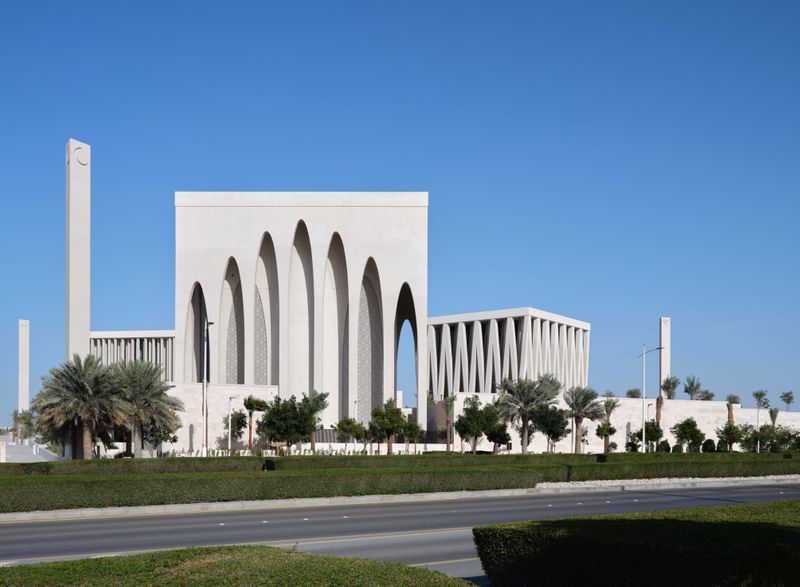
Abrahamic Family House / Adjaye Associates
The multi-faith complex has attracted global attention for its message of religious tolerance as well as its striking architectural design. The names of the three separate iconic houses of worship in the Abrahamic Family House complex are officially unveiled as “Imam AlTayeb Mosque,” “St. Moses ben Maimon was a prolific and influential Sephardic Jewish philosopher of the Middle Ages. Ornate chandeliers, a feature of most mosques, are replaced by discreet and powerful spotlights. The high ceilings are domed so the sound richly reverberates, while the soft auburn-coloured carpet comes with ingrained lines to guide worshippers when standing in prayer. The recently opened Abrahamic Family House truly brings people and cultures together — with every design and detail not only embracing diversity, but also promoting humanity and nurturing mutual religious understanding.
Europe's best new building
The synagogue's layout was designed to be "as flexible as possible" to allow for changing seating formations, depending on the congregation, and includes a traditional mikveh – a bath used for ritual immersion. Other design elements within the church include geometric pews formed from traditional hard-wearing oak and a purposefully minimal central crucifix that aims to welcome worshippers from all denominations. These were designed to evoke the notion of "a shower of ecstatic redemption", according to the architecture studio. The mikveh is located adjacent to the entrance and is composed of limestone walls. A skylight punctures through a textured, monolithic ceiling, allowing light from above to enter the intimate space of the mikveh. Along two corners of the courtyard are spaces for ablution, screened by bronze gates that formally echo the seven arches that break up each façade of the exterior form.
This architectural project arose as a result of the UAE declaring 2019 as the Year of Tolerance. “The Abrahamic Family House is a space to learn and to get together,” a representative told invited journalists at a press preview this week. The Abrahamic Family House's design, by Ghanaian-British architect Sir David Adjaye, captures the values shared between Judaism, Christianity and Islam. The names of the three houses of worship are Imam Al Tayeb Mosque, St Francis Church and Moses ben Maimon Synagogue.
Other projects planned for the island include Foster + Partners' long-awaited Zayed National Museum and architect Frank Gehry's Guggenheim museum scheduled to open in 2025. The complex was included in ArchDaily’s list of 23 most anticipated buildings to open in 2023, along with Studio Gang’s Museum of Natural History Expansion in New York, US and OMA’s The Buffalo AKG Art Museum. From the same list, Snøhetta’s Esbjerg Maritime Center in Denmark has already opened earlier this year. Throughout the day, the entirety of the interior is constantly in luminous flux, reminding visitors of their proximity with that which is transcendent and divine. Framed by date palms to symbolize entrances and punctuated by planters with regional vegetation and water features for cooling, the garden becomes a climate-moderated space of collective respite. Profound or mundane moments are cultivated throughout, encouraging the celebration of collective history and collective identity at all scales.
Nowadays, the home is in use by its owner, as well as for film shoots, special events and occasional tours. The two layers of mashrabiya produce circular spots of sunlight on the cream-coloured carpet. Unlike traditional mosques, the Ahmed El Tayeb Mosque only has four visible pillars but the main arc of the mosque serves as the fifth pillar. Air ducts, meanwhile, are craftily hidden behind the mashrabiya to create a smooth wall.
The Abrahamic Family House will be a beacon of mutual understanding, harmonious coexistence, and peace among people of faith and goodwill. It consists of a mosque, church, synagogue, and educational center to be built on Saadiyat Island, the cultural heart of Abu Dhabi in the United Arab Emirates. Through its design, it captures the values shared between Judaism, Christianity, and Islam, and serves as a powerful platform for inspiring and nurturing understanding and acceptance between people of goodwill. The vision for the Abrahamic Family House originated after the signing of the Document on Human Fraternity by Pope Francis and Grand Imam Ahmed Al-Tayeb in February 2019.
The mosque is facing the holy city of Makkah and can accommodate up to 322 worshippers standing shoulder to shoulder. Outside the church is a baptistry, a shallow pool shaped in the form of a perfect triangle, which is another Christian symbol of divinity. Also noteworthy are the two uneven columns at the entrance of the church which express descent (incarnation) and ascent (resurrection) that are central to the Christian faith. Throughout the venue, there are small calming pools of water, a symbolic element of purity, designed in the shape of a triangle, denoting the three religions on site.
“Visitors are invited to experience each of the three houses of worship and discover the key tenets of each Abrahamic faith. Each building is a perfect 30-metre cube, with austere interiors, and can accommodate between 200 and 320 worshippers, depending on whether they are seated or standing shoulder to shoulder. The crucifix in the middle of the prayer hall is absent of detailed features, designed as such to welcome all denominations of Christianity. In contrast to most Catholic churches, there are no representations of Jesus or the Holy Trinity. The geometric pattern covering the windows is inspired by Mashrabiyya, a traditional Islamic architecture, allowing natural light to filter through the latticework in patterns on the floor. The white marble interior has several ceiling domes to amplify sound as it travels around the room.
A criss-cross design in wood rises 30m above a shrouded, sanctified area of communal prayer in the centre. The metal mesh material that hangs above the worshippers symbolises the tents in which people used to pray. According to the architecture firm, the plinth references the universal concept of a mound, which intends to move people closer to higher things and encourage interfaith dialogue. With access to each chamber’s courtyard, it is a place of convergence, rather than divergence. A destination in itself, the raised garden creates a viewing platform to take in all three religious structures, promoting a sense of harmony and interconnectivity whilst asserting their individualism. Light filters through the delicate GRP latticework of the mashrabiya screens, which circulate air while maintaining privacy.
And finally, the country’s first purpose-built synagogue is named after Moses Ben Maimon, a Jewish philosopher who was born in 12th century Cordoba, Andalusia. The synagogue, showing on its walls Judaism’s Ten Commandments, heavily features triangles in its architecture, referring to Prophet Abraham's tent, an emblem of security and hospitality. Meanwhile, His Eminence Ahmed El-Tayeb Mosque has seven arches, a significant number in Islam, on its facade. Under a high ceiling, its exterior and interior walls are embellished with bedazzling patterns, welcoming natural light inside.


No comments:
Post a Comment